

The Union budget marks a structural shift in how India connects fiscal planning with digital acceleration. Rather than focusing only on spending announcements, this year’s policy blueprint emphasizes stability, infrastructure expansion, and technology-driven efficiency. As a result, the IT sector and digital transformation ecosystem stand to benefit from measurable reforms backed by clear numbers.
Union Budget 2026 and the Data Behind Digital Growth
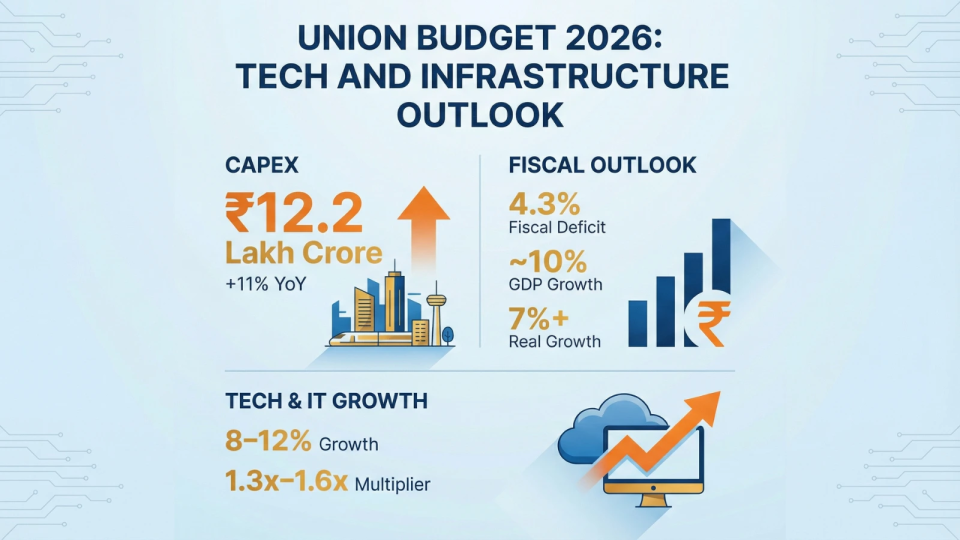
Under the Union Budget 2026, capital expenditure has increased to ₹12.2 lakh crore, up 11% year-on-year. Since infrastructure projects now include digital systems such as cloud, cybersecurity, and analytics, higher public capex directly supports technology spending.
The fiscal deficit target stands at 4.3% of GDP, while nominal GDP growth is projected to nearly 10% (real growth above 7%). Given that India’s IT sector typically grows at 1.3x–1.6x GDP, this suggests a potential 8–12% growth outlook for IT services in the coming cycle.
Safe Harbour Expansion: Stronger Margin Visibility for IT Services
With the Union budget, the safe harbour threshold for IT services has increased from ₹300 crore to ₹2,000 crore, with a standardized 15.5% margin framework. This significantly simplifies transfer pricing compliance.
The result is lower litigation risk, faster tax closures, predictable margins, and reduced administrative costs. For mid-sized and scaling IT firms, this improves earnings visibility and enhances EBITDA forecasting accuracy by reducing compliance-related uncertainty.
Learn more: How Digital Transformation Is Helping Small Businesses Scale Faster with Cloud, AI, and Data
Semiconductor Investment and Data Infrastructure Acceleration
An allocation exceeding ₹76,000 crore for semiconductor expansion strengthens domestic chip manufacturing and reduces long-term supply chain dependence. This is critical for AI, IoT, cloud computing, and high-performance workloads that rely on stable hardware availability and predictable pricing to support digital transformation at scale.
In parallel, data center incentives are projected to support 20–22% CAGR growth through FY28. As more global workloads are hosted in India, the country’s digital infrastructure deepens, creating stronger capacity and scalability for IT services and enterprise transformation initiatives.
Digital Demand Multiplier Across Sectors
Importantly, digital transformation is no longer confined to the IT industry alone. With increased public capex, sectors such as transport, energy, finance, and healthcare require advanced software systems.
For example:
- Smart railways need predictive analytics
- Urban development projects need IoT monitoring
- Financial services demand cybersecurity upgrades
- Healthcare infrastructure requires digital health records
Thus, the digital demand pipeline expands horizontally across industries. This multiplier effect strengthens the technology ecosystem beyond traditional outsourcing services.
Why the Timing of Union Budget 2026 Strengthens Digital Momentum
Although short term market volatility is expected, structural reforms typically create long term stability. Lower compliance burdens, disciplined fiscal targets, and infrastructure led investment together to build a stronger foundation for sustained digital growth.
More importantly, policy clarity reduces uncertainty. When economic direction is predictable, businesses accelerate investments in cloud migration, automation, AI, and enterprise modernization. In that sense, the Union budget functions like a system optimizer by streamlining inefficiencies and reinforcing the digital backbone of the economy.
Union Budget 2026 Accelerates India’s Structural Shift Toward Digital Leadership
In conclusion, the Union budget 2026 is less about isolated announcements and more about structural optimization. Higher capex, fiscal discipline, compliance simplification, semiconductor investment, and data center incentives collectively create a supportive environment for technology-led growth.
By aligning fiscal planning with digital transformation, this year’s framework reinforces India’s ambition to remain a global IT powerhouse while strengthening domestic infrastructure at the same time.
FAQs
1. How does Union Budget 2026 impact the IT sector?
It improves margin predictability, reduces compliance risks, and boosts digital demand through higher infrastructure spending.
2. What is the significance of the safe harbour expansion?
It increases the turnover eligibility to ₹2,000 crore and standardizes margins at 15.5%, reducing transfer pricing disputes.
3. Why is semiconductor investment important?
Strong semiconductor infrastructure stabilizes hardware supply, enabling AI, cloud, and digital transformation growth.
4. How does higher capital expenditure support digital transformation?
Infrastructure projects increasingly require digital systems, analytics, and cybersecurity solutions, creating new IT demand.